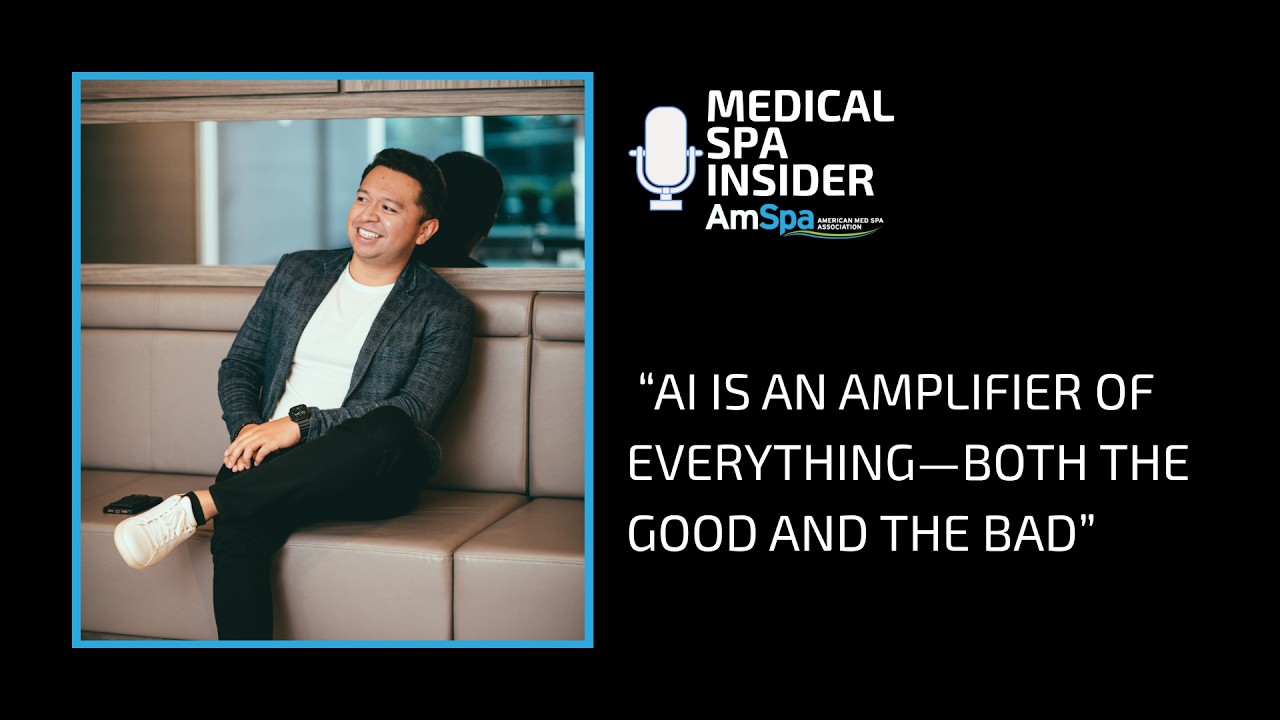
Aesthera Marketing founder Hugo Fernandez joined AmSpa founder Alex Thiersch on the Medical Spa Insider podcast to talk about how AI is reshaping patient discovery. Here’s the full breakdown.
I’ll say the uncomfortable part first, because it’s what reframed everything else for me.
I’ve spent fourteen years building a marketing agency. And I hate to scare other marketers, but most of the value we create is a human sitting behind a computer clicking buttons. Launching ads. Building websites. Doing SEO. That is the honest description of the work.
An AI can take over a computer and do most of that now.
And this is the worst it will ever be.
I went a long way down the agentic AI rabbit hole recently — not reading about it, actually testing how much of a real workflow it could execute end to end rather than just describe. I came out more convinced than I went in. Not frightened, exactly. Just clear that the ground has moved, and that everything downstream of it moves too.
Including how your patients find you.
These systems learn slowly, then all at once.
There’s a detail from the Google DeepMind research that I think about constantly.
They set a system loose on Pong. And it is genuinely terrible. It cannot score a single point. You’ve got a room full of PhDs and millions of dollars in funding watching a computer lose at Pong, and from the outside it looks absurd. Why would anyone sit there for this?
Then months later it scores a point, and everyone loses their minds. Then it’s bad again for weeks. Then it wins. Then it is unbeatable.
That’s the shape. Slow, slow, slow — then all at once.
People saw ChatGPT in 2022 and reasonably assumed they had a few years to adjust. What actually happened is a seismic shift compressed into a handful of months.
I’m not telling you this to make you anxious. I’m telling you because the pattern means the window to get ahead of it is measured in months, not years.
AI is an amplifier — of the good and the bad.
The framing I keep coming back to is this: AI is an amplifier.
You’ve already seen the bad version. You get an email and you can smell the ChatGPT on it. You want to send it back and say, “rewrite this in your own words.”
I actually did this with a team member. They sent me an analysis that was clearly machine-generated — seven paragraphs that never landed anywhere. I told them: I don’t know if I’m debating the AI or debating you. Go synthesize it and tell me what you actually think.
Their real opinion was two sentences long. They’d hidden it because they thought it was too blunt. I’d take those two blunt sentences over seven paragraphs of hedging every single time.
But run it the other direction and the amplifier works for you. If you have taste as a designer, it’s a new canvas. If you’re a strong communicator, that comes through in the copy. These models are trained on the best copywriters who ever lived, on human psychology, on what actually moves people. Learn the principles. Use them. Just don’t outsource your judgment.
The line is simple: use AI to amplify what you’re already good at. Don’t use it to manufacture slop.
Especially in healthcare, where bad advice at scale isn’t just ineffective — it’s a genuine risk. And the platforms will bury you for it anyway.
The three things AI weighs before recommending you.
When people ask whether AI-generated content still ranks, the answer isn’t about the content. It’s about the source.
Three things decide it:
- Relevance. Is this actually useful to the person asking?
- Authority. Are you the right entity to be saying this?
- Trust. Does your track record support the claim?
Here’s the test I use. If I decided tomorrow to publish authoritative content on legal compliance in the aesthetics industry, I’d fail on all three. I’m not a lawyer. I don’t run the industry’s conferences. Nobody knows me in that context. These systems know that.
But a provider writing about the treatment they perform forty times a month? That’s real authority, and it gets rewarded.
Your treatment room produces content AI cannot fake.
The conversation Alex and I had on that podcast is what I’d call an n of one. Unless the multiverse is real, that exact exchange happened once, between two specific people. AI can’t generate it.
Your practice runs on n-of-ones. Every appointment is a unique interaction with a unique person about something that matters to them. Your competitor down the street might perform the identical treatment at the identical hour — but not with that patient, in that room, on that day.
Susie came in on a Tuesday. It was her day off. She’d had a rough stretch and decided to spoil herself.
That story resonates in a way the ten-thousandth Botox promo graphic never will. And it’s yours alone.
The multiplication is where most practices leave money on the table. One great experience should become:
- A social post
- A video testimonial from the patient
- A before-and-after with real context around it
- A written case study on your website
- A detailed five-star review that names the actual treatment
One appointment. Five crawlable, indexable, quotable assets.
Everyone tells you to “create original content.” This is what that actually looks like in a med spa — and AI treats it as exactly that.
What discovery looks like now.
Here’s the pattern, and we are very close to it being routine.
It’s 11:12 PM. Someone notices some texture on their skin. They’re not alarmed, just curious. So they open ChatGPT and upload a photo.
It suggests acne scarring. They push back — they’ve never had acne. It offers some over-the-counter options. Those don’t work. So they come back and ask what’s next. Now it’s recommending microneedling, or a CO2 laser, or a specific facial. And it names three providers.
Then they say: book me an appointment.
Notice what didn’t happen. They never typed “med spa near me.” They never compared ten websites. The AI already knew where they live, what they’ve asked about before, what they prefer — because it’s a multi-year relationship, not a search query. So the recommendation it gives is dramatically more targeted than anything traditional search would surface.
Now extend it. Someone gets engaged. That’s not one purchase — it’s catering, venue, dress, timeline. And in the middle of that plan, an AI can map out exactly when they need to start their chemical peels, which practice does their laser work, when to book the facials so everything peaks on the right date. It can even order the over-the-counter products.
Buyer behavior is changing. The fundamentals underneath it aren’t.
That AI still crawls your website. Your Google Business Profile. Your Yelp. Your Instagram and Facebook. Your reviews. It runs a complete scan and then serves a richer, more personal result. The inputs are the same ones we’ve been talking about for twenty years. There just needs to be more of them, and they need to be connected.
The agentic booking gap.
The part practices should be thinking about right now: when that person says “book me an appointment,” an agent needs somewhere to send that request.
It looks at their calendar, finds a window, then looks at your calendar. If your tech stack, your EMR, your scheduling software can receive that request — it books, confirms, and tells them to grab lunch on the way because they’ve got a stacked day.
If your systems can’t receive it, the booking goes to the practice down the road that can.
We’re very close to this being routine. The practices that win it will be the ones who did the unglamorous setup work early.
The unglamorous checklist.
This is the part that doesn’t make it onto conference slides.
Location data.
If your address appears in exactly one spot on your website, that’s a problem. Specific treatments need to connect to specific locations — critical if you operate more than one.
Schema markup.
The structured code that tells machines what your business is, where it is, and what it offers. Most med spa websites have none. (This post has three schema types on it, for whatever that’s worth.)
Structured FAQs.
Real questions with direct answers, formatted so an AI can parse and quote them. This is how you get cited at 11 PM.
Source tracking.
Can your EMR tell you where a booking originated? Many can’t. If your only data is “I found you online,” you’re flying blind — and you cannot optimize what you cannot measure.
Reviews with detail.
“Great staff!” is worth nothing to a crawler. A review naming the treatment, the concern, and the outcome is a searchable asset.
It’s more technical than “publish more content.” That’s the whole point. If you’d rather have someone else run this checklist against your site, we do complimentary marketing audits for aesthetic practices.
Three things to do this week.
Alex asked what a busy practice owner should do first. Here’s my answer.
1. Become a user.
Download ChatGPT, Claude, and Gemini. Use them in your personal life first — meal planning, travel, whatever. You cannot make good decisions about a technology you’ve never touched.
2. Bring your team with you.
If you fear something, you’ll avoid it. Share how you’re using it. Show examples. Make it feel like an opportunity rather than a threat, because your team’s instinct will follow yours.
3. Ask better questions of your partners.
Not “here’s what I want you to do” — that’s like walking into your doctor’s office and prescribing your own medication. Ask your marketing agency and your software vendors thoughtful questions about how they’re adapting. They might not have every answer. They should absolutely be thinking about it.
Why we built Aesthera.
We launched Aesthera Marketing earlier this year, spun out of Just Digital, where we’d already been serving aesthetic practices for twelve of our fourteen years. We’d just never formalized it.
The reason is simple. A generalist agency spreads its team across law firms and dental practices and e-commerce. A dedicated one hires people who know your treatment menu, your buyer journey, and what a consult actually looks like. Same work underneath — ads, SEO, websites, email — but the fluency is different, and it shows in the results.
We’re built for aesthetic practices between $1M and $5M who are thinking about a second location or ready to break through a ceiling.
By my estimate, roughly 95% of businesses still aren’t really using these tools at all. That’s not a warning. That’s a window.
Frequently asked questions.
Will AI replace traditional SEO for med spas?
No. AI platforms still crawl websites, reviews, Google Business Profiles, and social media to build their recommendations. The fundamentals — a solid site, accurate location data, strong reviews — matter more than ever, not less. What changes is the depth and connectedness those signals require.
Can I use AI to write my med spa’s content?
Yes, with human oversight. AI is an amplifier of quality in either direction. Content must be relevant, genuinely useful, and reviewed by someone with real clinical or business authority. Publishing unreviewed AI content in healthcare risks both patient harm and search deranking.
How do AI platforms like ChatGPT decide which med spa to recommend?
They scan your website, Google Business Profile, Yelp, and social presence, then weigh relevance, authority, and trust — combined with what they know about the individual user’s location, history, and preferences.
What is agentic AI booking?
AI agents that don’t just recommend a provider but complete the booking — checking the patient’s calendar, checking yours, and confirming the appointment. It requires an EMR and scheduling stack capable of receiving those requests.
What should a med spa fix first?
Location data on every treatment page, schema markup, structured FAQs, and source tracking in your EMR. These are the technical foundations that determine whether any of your content gets found.
Want to know where your practice actually stands?
Book a complimentary marketing audit. We’ll look at where AI already surfaces you, where it doesn’t, and the technical foundations that separate the two.
Book a marketing audit ↗︎
Hugo Fernandez
Founder & CEO at Aesthera Marketing. Fourteen years building marketing systems for aesthetic practices.